
When we were filling out our mission papers, Catherine listed her extensive experience in introducing the church’s self-reliance program. She helped establish a pilot program in her ward and stake as a Stake Relief Society President as well as the stake Self-Reliance specialist. It was no small surprise that we were called as Welfare Self-Reliance (WSR) missionaries, certainly a big surprise that we were called to France.
“The aim of the self-reliance initiative is to help individuals help themselves become self-reliant. Self-reliance is more than having a good job, food storage, or money in the bank. Self-reliance is ‘the ability, commitment, and effort to provide for the spiritual and temporal necessities of life for self and family. As members become self-reliant, they are also better able to serve and care for others,’ and work is enthroned as a ruling principle in their lives” (Handbook 2: Administering the Church [2010], 6.1.1).
Over the last five months, We have been studying the self-reliance program. There are four core classes in the Self-Reliance initiative:
Personal Finances
Find a Better Job
Starting and Growing my Business
Education for Better Work
In addition to these core classes, the church offers two courses for learning English:
EnglishConnect 1 and 2
There is an EnglishConnect 3 course which is taught through BYU pathways and is to help individuals learning English prepare for entering the BYU Pathways education system.
There are four additional courses offered by the church to strengthen self and family:
Emotional Resilience
Strengthening Marriage
Strengthening Family
Addiction Recovery
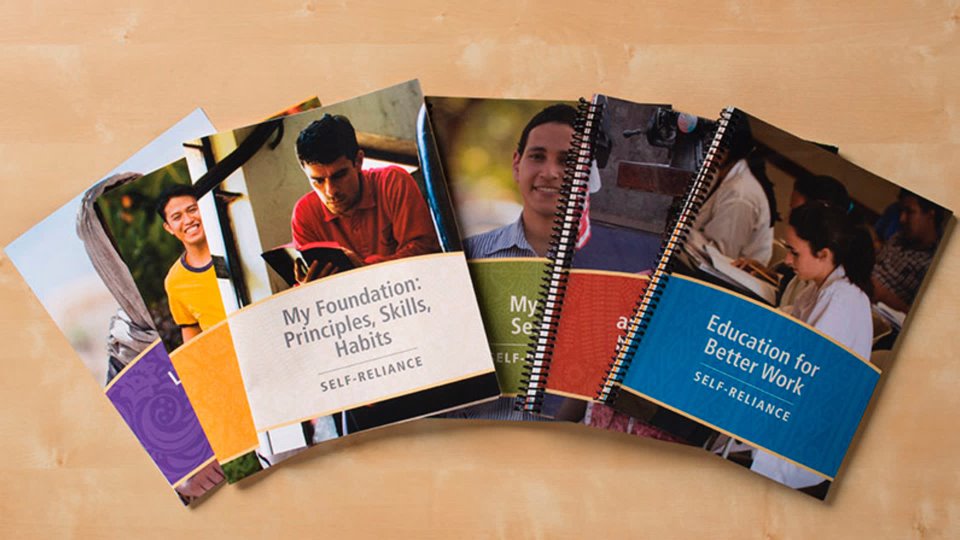
In studying these programs, I have come to better understand the meaning and purpose of Self-Reliance as taught by the church.
“Without self-reliance one cannot exercise these innate desires to serve. How can we give if there is nothing there? Food for the hungry cannot come from empty shelves. Money to assist the needy cannot come from an empty purse. Support and understanding cannot come from the emotionally starved. Teaching cannot come from the unlearned. And most important of all, spiritual guidance cannot come from the spiritually weak.” (The Celestial Nature of Self-reliance, Marion G. Romney, October 1982)
President Thomas S. Monson taught: “Let us be self-reliant and independent. Salvation can be obtained on no other principle”
(“Guiding Principles of Personal and Family Welfare,” Ensign, Sept.
1986)
“All things unto me are spiritual, and not at any time have I given unto you a law which was temporal” (D&C 29:34)
“We invite you to diligently study and apply these principles and teach them to your family members. As you do so, your life will be blessed. You will learn how to act on your path toward greater self-reliance. You will be blessed with greater hope, peace, and progress.” (The First Presidency, in the introduction of all self-reliance manuals)
As a young father, I remember talking with one of the members of our ward. He was well off, but his whole demeanor, his entire focus was on making money. He was sincere in his belief that the difference he made in God’s kingdom depended on the amount of money he had to further His work. Once he was really wealthy, he would “make a difference in the church”. He wasn’t quite there yet, but his spacious house, large boat and other earthly possessions told a different story. He entirely missed the point. If all the Lord is after is money, he knows where all the riches of the world are hidden and has but to direct his leaders to untold wealth. Self-reliance does not separate the temporal and the spiritual. They are one. Being self-reliant does not dictate we have a lot of money and need to rely on no one else.
“Self-reliance is not the end, but a means to an end. It is very possible for a person to be completely independent and lack every other desirable attribute. One may become wealthy and never have to ask anyone for anything, but unless there is some spiritual goal attached to this independence, it can canker his soul.” (The Celestial Nature of Self-reliance, Marion G. Romney, October 1982)


Could not a homeless person, or a homeless family be self-reliant in the eyes of the Lord? Missionaries in the France Lyon mission assembled homeless kits, not as a dole, but with the goal to include messages of hope and inspiration, hand written notes to lift up heavy hearts, to distribute these kits as the spirit directs to those whom they encounter during their service.
What is the Lord’s view of someone who is self-reliant?
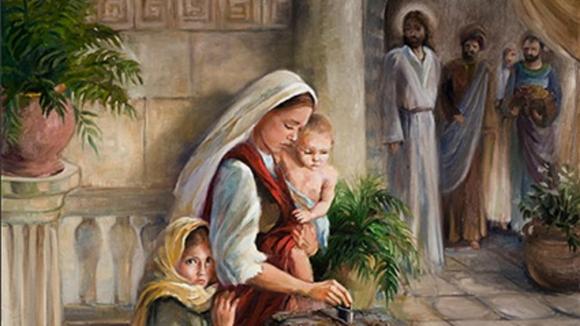
The widow giving her mites at the temple may have been ‘dependent’ in the world’s view, but she was one of the most self-reliant people mentioned in the New Testament. I love the image of the widow as a young woman with children, teaching her children about trust, faith, action and service. In other words, to be self-reliant.
“Self-reliance is evidence of our trust or faith in God’s power to move mountains in our lives and to give us strength to triumph over trials and afflictions.” (My Foundation, Self-reliance is a principle of salvation)
Self-reliance has little to do with our ability to make money, the extent of our possessions or even the amount of food storage in our closets. Self-reliance is doing all that we are capable to spiritually and physically prepare ourselves to care for our families, care for others and wear ourselves out in His service.
 Latter-Day Saints