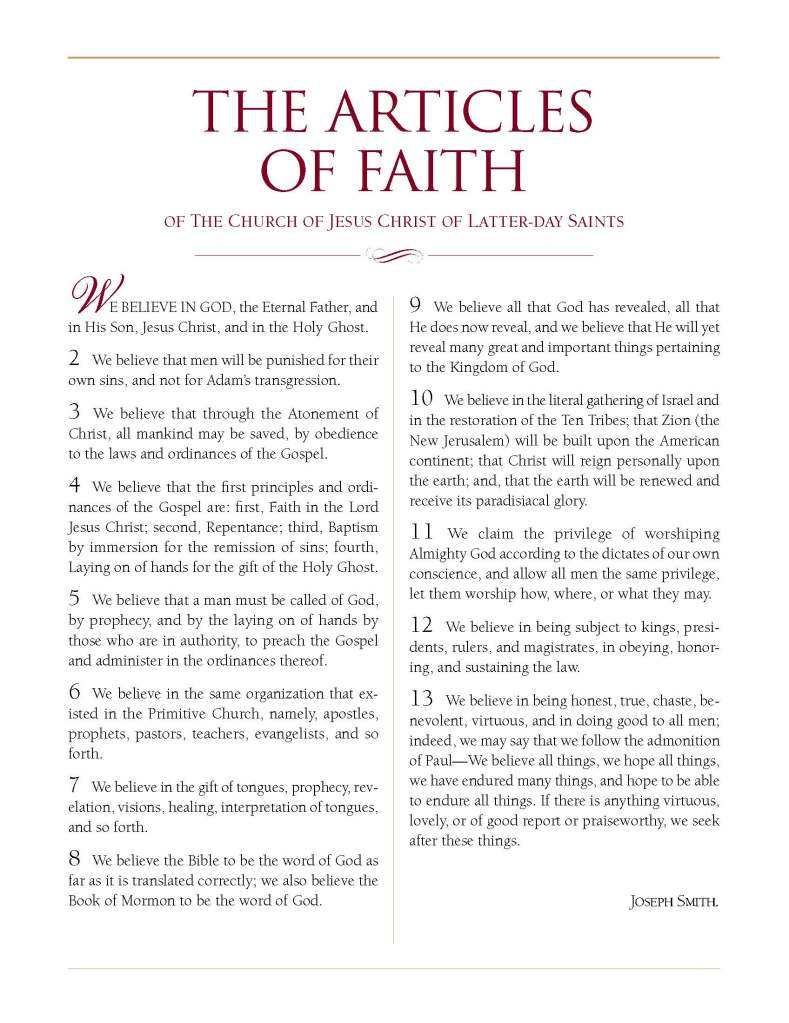
The 13 Articles of Faith written by Joseph Smith encompass the basic tenants of the restored gospel. They describe the God Head, principles and ordinances of the Gospel, the Atonement of Jesus Christ, church organization, canonized scripture and continuing revelation. The restored church is led by priesthood authority and directed by revelation. It is the 13th article of faith that has the greatest impact on my studies, my actions and relationships in daily life.
13th Article of Faith
We believe in being honest, true, chaste, benevolent, virtuous, and in doing good to all men.
I cannot think of a more concise statement that directs my relationship with others; from my wife and children, family and friends, to acquaintances and complete strangers.
Benevolent is a key word here. Someone who is benevolent is humane, compassionate, caring and generous, indeed someone who does good to all mankind. For me, it brings to mind ‘What Would Jesus Do’.
Indeed, we may say that we follow the admonition of Paul—We believe all things, we hope all things, we have endured many things, and hope to be able to endure all things.
Hope and endurance are the bedrock of our journey through this telestial sphere. We aspire, someday, to have the capacity to endure all things with a perfect brightness of hope, just as our Savior Jesus Christ “descended below all things’ (D&C 88:6) to bring about his Atoning Sacrifice. ‘Believe all things’ seems to imply a superficial sense of naivety and gullibility. This could not be further from the truth. Joseph Smith clarified this in the next phrase, drawing from Philippians 4:8:
If there is anything virtuous, lovely, or of good report or praiseworthy, we seek after these things.
There are no qualifications here. It does not say that we can only study the scriptures or conference talks. Please don’t misunderstand, these are compelling sources of wisdom and guidance. As Latter-day Saints, we are not limited by the source of knowledge, wisdom and inspiration; only by the truthfulness, purity and quality of that which we seek and find.
For example have much to learn and ponder from the beliefs and traditions of other faiths. Our experiences in France and Greece on our recent humanitarian mission left an indelible mark on our hearts. I admire the Greek people for their strong family traditions. For example, in Greece, Christmas is a muted affair, a few simple traditions on Christmas Day, but their celebration of Easter is a three month event; traditions focused on the family and on Christ. I want to bring that same devotion home to my family. We have just a few chapters in the bible describing the birth of Christ. The rest of Scripture celebrates his Atonement and resurrection. Like the Greek people, our celebrations should reflect this.
In addition to watching and learning from other people, other faiths, I love studying the works of Christian apologists and writers because of their unique perspective, in addition to their common love of Jesus Christ.
CS Lewis is the most quoted Christian apologist in the world. I revel in his works of faith as well as his works of fiction. Justin Martyr, Augustine of Hippo, Thomas Aquinas have left enduring footprints in the defense of Christian faith. St Francis of Assisi, though not an apologist in the sense of defending the Christian faith, is an inspiring example. He founded the Franciscan order and lived a life of poverty and humility.
A recent apologist, Timothy Keller, has written such books as “The Meaning of Marriage”, casting marriage in a Christian light. “The Reason for God” and “Making Sense of God” respond admirably to books by noted atheist Richard Dawkins, “The God Delusion” and “The Blind Watchmaker”.
Some of my recent favorites include Joseph F. Girzone, who wrote a series of novels centered on Jesus who comes back to earth as an itinerant carpenter named Joshua. Through these stories, he challenges long standing animosities such as such as Catholics vs. Protestants in Northern Ireland, and policies in the Catholic church he felt were at odds with the teachings of Christ.
‘Left behind’ by Tim LaHaye and Jerry B. Jenkins, is a series of 16 books telling the story of the apocalypse, the end of the earth and the second coming of Christ. Through the eyes of fictional characters, the authors attempt scriptural accuracy and give an interesting glimpse into the last days from an evangelical viewpoint.
Of the numerous examples I could cite, my last example is John Senior, an advocate of traditional education rooted in the classics and humanities. His book “The Death of Christian Culture” contains a number of pithy quotes. Though written in the 1970’s, they are especially relevant today. Here are some of my favorites:
“Christian culture is the cultivation of saints.”
He extends that thought to families and firmly roots the family as the basis of Christian society and culture:
“In the ordinary daily life of men in Christian culture, who work not only in the sweat of their brows, but for the love of their families, there is also love of work. When men cut wood or got to war or make love to their wives, or when women spin or wash and reciprocate that love, they are working not only to get the job done so that children will be born and grow and have clothes to wear and food to eat. They are working so that those children will one day be saints in heaven. They are working as the very instruments of God’s love to create a kind of heavenly garden here and now in the home, by which each axe becomes a violin, each loom a harp, each day a prayer, each hour a psalm.”
He affords a strong front on religious relativism:
“The Christian must reply to all varieties of transcendental universalism, though it may seem arrogant: ‘No. We do not worship the same God, you in your way, I in mine. I worship the one true God and you worship idols.’ “
“It is said that Christianity, if it is to survive, must face the modern world, must come to terms with the way things are in the sense of the current drift of things. It is just the other way around: If we are to survive, we must face Christianity. The strongest reactionary force impeding progress is the cult of progress itself, which, cutting us off from our roots, makes growth impossible and choice unnecessary.”
Closely related is moral relativism. Though the examples he cites below are a bit out of date and we can add a hefty number of currently espoused aberrant behaviors, his conclusion is strikingly relevant today:
“The enemy I am talking about is the one lurking in the guts of the whole nation like an invisible and deadly virus. It is not an action, but an attitude that says everyone has the right to arson, murder, rape, because doing those things is necessarily included under the rubric of freedom, of doing what one wants . . . In a word, we have raised the abnormal and aberrant to the condition of a human right. The beast is loose among us, and he is welcome in our universities and our homes.”
The following quote on divorce is a strong statement we do not see in today’s soft, fear to offend dialogue. It may be controversial, even among Christians, but rampant concepts of “starter marriages” and fleeting relationships strikes at the core of family:
“Modern marriage, contradicted in its very pledge by the universal acceptance of divorce, really is a ‘legal cloak of prostitution’ ”.
A sweeping statement like ignores the instances where divorce is necessary to escape abuse and infidelity. The premise though, fits today’s view of marriage in far to many instances.
The works of apologists such as C.S Lewis and John Senior are timeless because the Christian culture and doctrine they espouse are timeless. I cherish the scriptures and the writings of our modern-day prophets and apostles because of the true doctrine they teach and the life they espouse. I love to complement my studies with examples of the good people around me, and the writings of these brilliant and inspired apologists because of the perspective they bring and the faith they promote.
“If there is anything virtuous, lovely, or of good report or praiseworthy, we seek after these things.”
 Latter-Day Saints